How Long Should a Statement of Purpose Be? Your Complete SOP Guide for International Students
May 21, 2026
Your statement of purpose can be the difference between an acceptance letter and a rejection. It’s the one part of your application where grades, test scores, and transcripts step aside and you get to speak directly to the admissions team as a real person with real goals.
But one of the most common questions international students ask is a deceptively simple one: how long should a statement of purpose be?
In this guide, we’ll answer that question clearly and give you everything else you need, from understanding the purpose of an SOP to knowing exactly what to write in each section, so you can submit a purpose application with confidence.
What Is a Statement of Purpose?
A statement of purpose (SOP) is a short, focused essay included in your university or college application. It outlines who you are, why you want to study a particular program, what relevant experience you bring, and what you plan to do after graduation.
Think of it as your personal pitch to the admissions committee. While your transcripts tell them what you’ve achieved academically, your SOP tells them why it matters and why you deserve a place in their program.
A well-crafted SOP helps you:
- Stand out from thousands of other applicants with similar grades
- Show your enthusiasm, personality, and cultural fit for the institution
- Demonstrate your writing ability and communication skills
- Explain any gaps, career changes, or unusual circumstances in your background
SOP Meaning in Research and Graduate Applications
If you’re applying to a graduate program, postgraduate degree, or research-focused course, the term SOP meaning in research takes on extra weight. At this level, your statement of purpose is expected to go beyond general interest and demonstrate:
- A clear purpose of the study you wish to pursue
- Familiarity with the field, relevant faculty, or research areas at the institution
- A well-defined academic or professional problem you want to investigate or solve
- How the program specifically equips you to achieve your research goals
For research applications, admissions panels often include academics who will assess whether your proposed purpose of the study aligns with departmental strengths. Being vague here is one of the most common and costly mistakes applicants make.
What Is a Specific Purpose Statement?
A specific purpose statement is a clear, one-to-two sentence declaration at the heart of your SOP that answers: Why this program? Why this institution? Why now?
Rather than a broad opening like “I have always been passionate about business,” a specific purpose statement is precise:
“I am applying to the Master of International Business program at [University] to develop the cross-cultural management skills I need to expand my family’s logistics company into Southeast Asian markets.”
That single statement does enormous work. It tells the admissions team your background, your goal, and your reason for choosing this particular program, all in one sentence.
Every strong SOP is built around a specific purpose statement like this. It becomes your thesis, and every paragraph that follows should support and expand it.
How Long Should a Statement of Purpose Be?
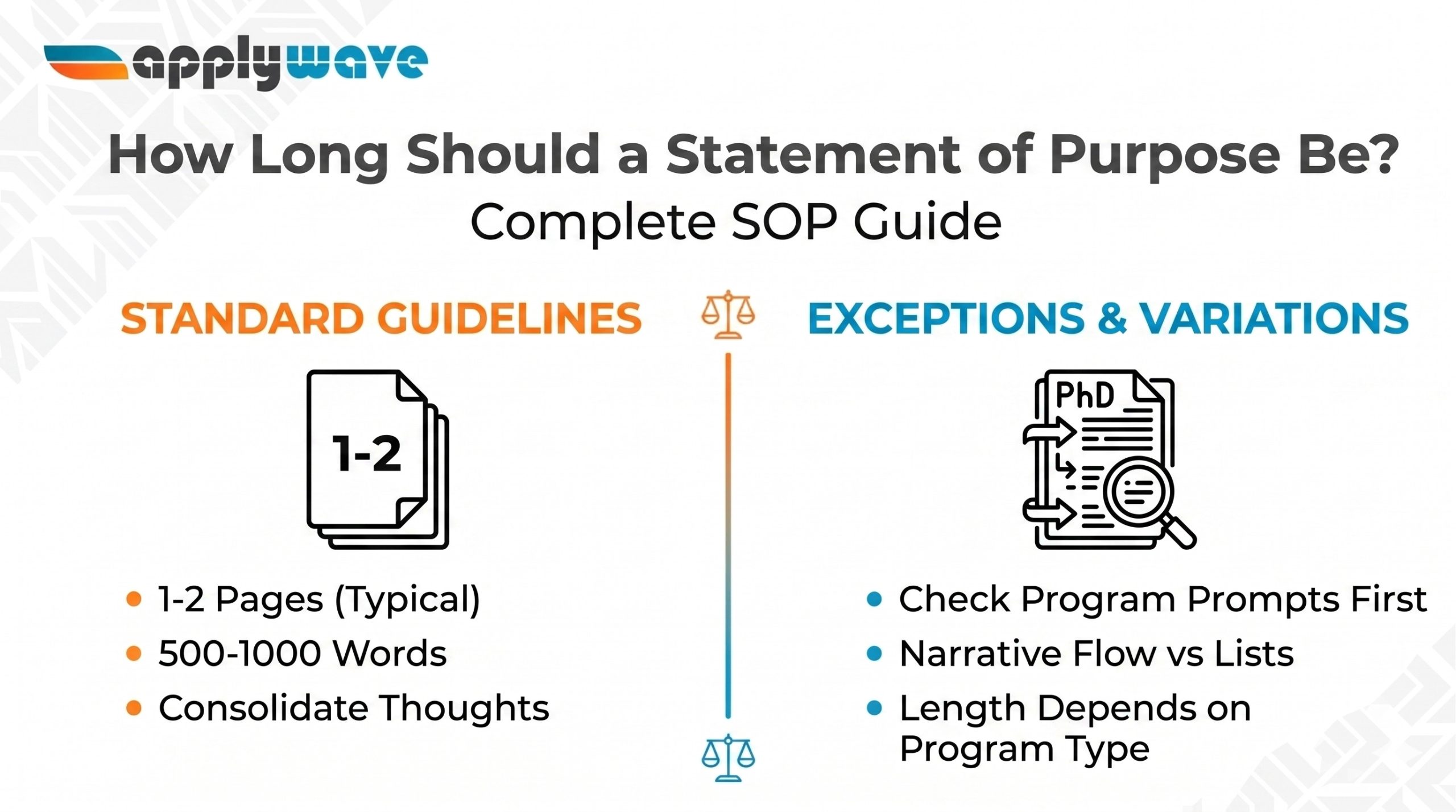
This is the question most applicants stress over, and the honest answer is: it depends on the institution’s instructions, but there are clear general guidelines.
Always Follow the Institution’s Requirements First
Before worrying about word count, check the application portal or program page carefully. Many universities specify:
- A word count (commonly 500 to 1,000 words for undergraduate; 500 to 1,500 words for postgraduate)
- A page limit (most commonly one page; sometimes two for research degrees)
- Formatting rules such as font size, line spacing, and margins
Following these instructions exactly is itself part of the test. It signals to admissions staff that you can read carefully, follow directions, and respect institutional processes. Submitting a 1,200-word SOP when the limit is 650 words will not impress anyone, no matter how well it’s written.
General SOP Length Guidelines by Study Level
| Study Level | Recommended Length |
|---|---|
| Certificate / Diploma | 300 to 500 words (often one page) |
| Undergraduate / Bachelor’s Degree | 500 to 650 words (one page) |
| Postgraduate / Master’s Degree | 700 to 1,000 words (one to two pages) |
| PhD / Research Degree | 1,000 to 1,500 words (one to two pages) |
How Long Should the Statement of Purpose Be for Research Programs?
For PhD, MRes, or research-intensive master’s programs, your SOP will typically sit at the longer end of 1,000 to 1,500 words. This is because you’re expected to articulate a research direction, demonstrate familiarity with the existing literature in your field, and explain how your background has prepared you for independent scholarly work.
Even at this length, every sentence should earn its place. Admissions readers are busy. A crisp, focused 900-word SOP almost always outperforms a padded 1,400-word one.
The Golden Rule
Write as much as the institution asks for and not a word more. If no length is specified, aim for one page (approximately 500 to 700 words) for undergraduate applications and one to two pages (700 to 1,000 words) for postgraduate applications.
Purpose of the SOP: What It Must Achieve
Understanding the purpose of an SOP helps you write one that actually works. Your statement needs to accomplish four things simultaneously:
- Introduce you as a person, not just a list of achievements, but your values, motivations, and perspective
- Demonstrate academic and professional readiness to show you have the background to succeed in the program
- Articulate clear goals, both what you want from the program and what you plan to do afterward
- Connect you specifically to the institution, explaining why this university, this faculty, and this program
A generic SOP that could apply to any institution is one of the biggest red flags for admissions teams. Personalisation matters.
What to Include in Your SOP: A Section-by-Section Breakdown
Opening Paragraph: Hook + Specific Purpose Statement
Skip the clichés (“Since I was young, I have always loved…”). Open with something concrete, such as a defining moment, a challenge you faced, or a question that drives your curiosity, and move quickly into your specific purpose statement. Tell the reader exactly what you’re applying for and why.
Your Academic Background
Summarise the qualifications, coursework, or training most relevant to the program. Don’t just list your degree; explain what you learned and how it shaped your thinking. For research applications, mention any thesis work, lab experience, or academic publications.
Relevant Experience and Achievements
This is where you show you’re more than your GPA. Include work experience, internships, volunteer roles, extracurricular activities, or projects that connect to your field of study. Be selective by picking two or three strong examples and explaining what you gained from each, rather than listing everything you’ve ever done.
Why This Program and Institution
This is where most SOPs fall short. Do your research. Name specific faculty members whose work interests you. Reference particular modules, facilities, research centres, or industry partnerships that align with your goals. Show that you’ve genuinely investigated the program, not just its ranking.
Your Goals: Short-Term and Long-Term
What do you want to achieve immediately after graduation? What’s your five-year vision? For international students, this often includes whether you plan to return to your home country, work internationally, or pursue further study. Be honest and specific, as vague aspirations aren’t compelling.
Closing: Confidence, Not Desperation
Close with a brief, confident restatement of why you’re a strong candidate and what you’re looking forward to contributing. Thank the admissions committee for their time. Keep it professional and avoid pleading or excessive flattery.
Common SOP Mistakes to Avoid
- Starting with a quote: it’s overused and rarely adds value
- Repeating your CV: your SOP should complement your resume, not duplicate it
- Being vague about your goals: “I want to make a difference” is not a goal
- Ignoring the word count: over or under the limit both signal carelessness
- Using AI-generated text: institutions are increasingly skilled at detecting this, and it undermines the entire point of a personal statement
- Sending the same SOP to every school: admissions readers notice, and it signals a lack of genuine interest
Assistance with Self-Care Activities NDIS Purpose vs. Academic Purpose Applications
It’s worth clarifying one point of terminology confusion. When international students search for “purpose application,” they’re referring to a statement of purpose for university admission, not a government funding or support application. If you’ve arrived here looking for guidance on your study abroad application, you’re in the right place.
Ready to Apply? Applywave Can Help
Applywave is the home of international students, offering a trusted platform where you can search, compare, and apply to hundreds of universities, colleges, and high schools worldwide, all in one place.
Once your statement of purpose is polished and ready, explore programs on Applywave and take the next step toward your study abroad goals. Whether you’re pursuing a bachelor’s degree, a master’s program, or a research qualification, we make the application process simpler, clearer, and faster.