College vs University in the USA: What Is the Difference and Which Is Right for You?
April 14, 2026
If you are planning to study in the United States, you have almost certainly encountered the words “college” and “university” used interchangeably, and wondered whether they actually mean the same thing. The short answer is: not exactly. This guide explains the difference between college and university in the USA, walks through every type of institution you might apply to, and helps you decide which is the better fit for your goals.
Quick Answer
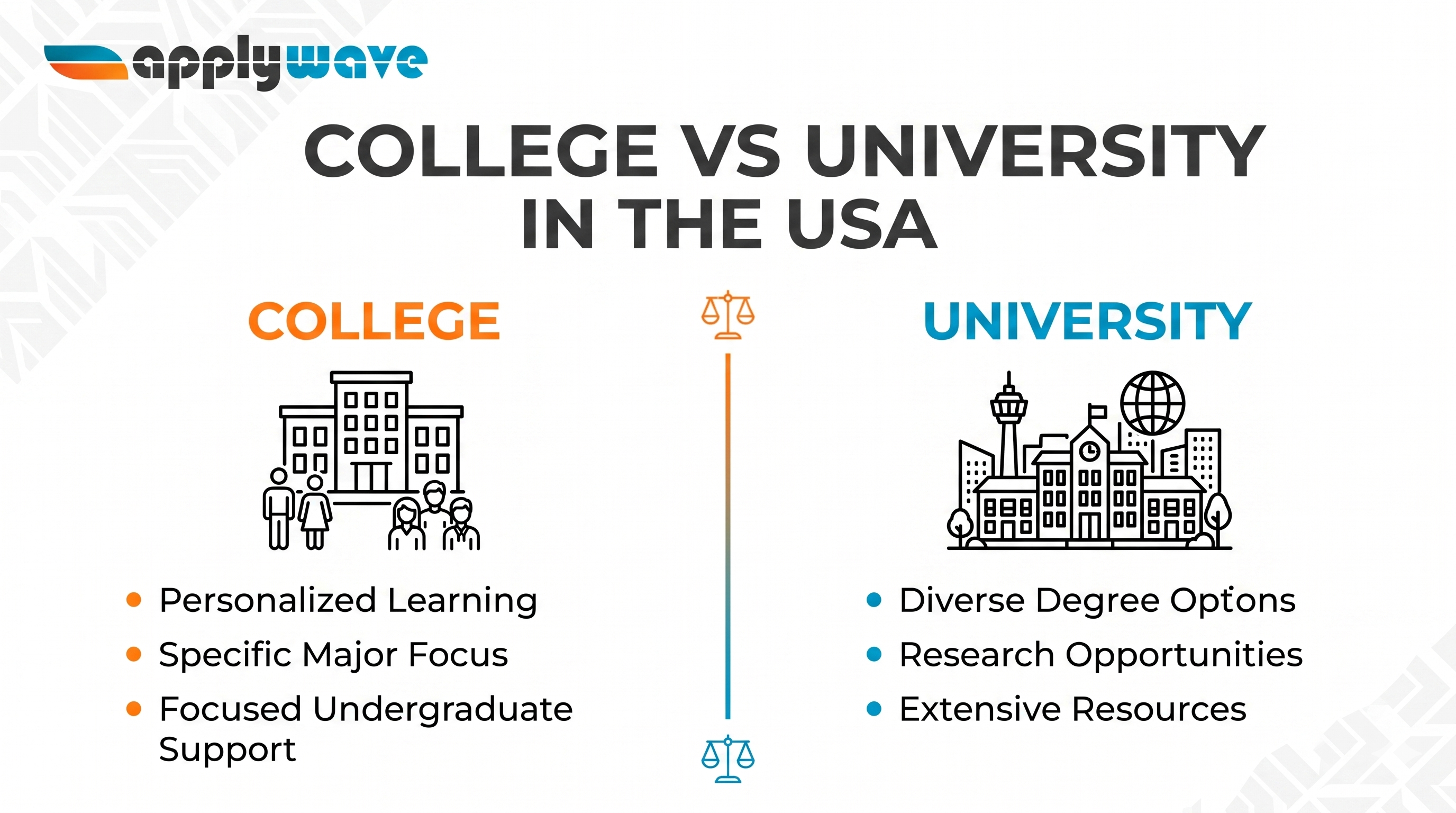
- A college in the USA typically offers undergraduate programs (bachelor’s degrees or associate degrees) and is usually smaller in size.
- A university offers both undergraduate and graduate programs (master’s, doctoral, professional degrees) and tends to have a greater emphasis on research.
- In everyday speech, Americans use “college” to mean any higher education institution, including universities. This is why you will hear people say “I’m going to college” even when attending a university.
- Neither term is legally regulated in the USA, so some institutions use them interchangeably regardless of what they offer.
What Is a College in the USA?
In the United States, a college is a postsecondary institution that primarily offers undergraduate degree programs. Most commonly this means a four-year bachelor’s degree, though some colleges, particularly community colleges, offer two-year associate degrees or vocational certificates.
The word “college” is used in several different ways in the US education system, which is part of what makes it confusing:
- As a standalone institution: A college can be an independent school offering only undergraduate programs, such as a liberal arts college or a community college.
- As a division within a university: Large universities are often divided into individual colleges. For example, Harvard University contains Harvard College (its undergraduate liberal arts division) as well as Harvard Law School, Harvard Medical School, and Harvard Business School. In this sense, a university is made up of colleges.
- In everyday speech: Americans routinely say “going to college” to refer to any kind of postsecondary education, including at a university. This is the most common source of confusion for international students.
Some well-known institutions call themselves colleges even though they offer graduate programs. Dartmouth College and Boston College are two prominent examples. This is because “college” and “university” are not regulated terms in the USA, meaning institutions can use whichever they prefer.
What Is a University in the USA?
A university in the USA is a postsecondary institution that offers both undergraduate and graduate degree programs. Graduate programs include master’s degrees, doctoral degrees (PhDs), and professional degrees such as the Juris Doctor (JD) in law and the Doctor of Medicine (MD).
Universities are typically larger than standalone colleges, both in terms of student enrollment and physical campus size. They are generally organized into multiple schools or colleges, each focusing on a different academic discipline or professional field. A single university might contain a College of Arts and Sciences, a School of Engineering, a Business School, a Law School, and a Medical School all within one institution.
Universities in the USA also tend to place a greater emphasis on research. Faculty at research universities are expected to produce original research and publications in addition to teaching, and universities are often home to large research centers, laboratories, and institutes. This research orientation has a direct impact on the undergraduate experience, which we explain in more detail in the research vs teaching section below.
College vs University USA: Key Differences Compared
The table below summarises the key differences between a college and a university in the United States.
| Feature | College | University |
|---|---|---|
| Degrees offered | Associate degrees, bachelor’s degrees; some offer master’s | Bachelor’s, master’s, doctoral, and professional degrees |
| Typical size | Smaller; often a few hundred to a few thousand students | Larger; often tens of thousands of students |
| Research emphasis | Lower; teaching is the primary focus | Higher; faculty research is a core mission |
| Internal structure | Usually a single academic unit | Divided into multiple colleges or schools |
| Class sizes | Often smaller; more direct professor access | Can be large, especially in first and second year |
| Graduate programs | Rarely offered | Core part of the institution |
| Cost | Community colleges are significantly cheaper; four-year colleges vary | Varies widely; public universities are lower cost for in-state students |
| Examples | Amherst College, Williams College, Santa Monica College | Harvard University, University of Michigan, Ohio State University |
| Regulated term? | No | No |
Are College and University the Same Thing?
In everyday American speech, yes. When Americans say “going to college,” they mean attending any higher education institution, including universities. As formal institutional categories, however, they refer to different types of schools with different program offerings and different emphases. For practical purposes as an international student, focus on what programs, degrees, and research opportunities the institution offers rather than what it calls itself.
What Kinds of Colleges Are There in the USA?
Understanding the different types of colleges and universities in the USA helps you narrow down where to apply based on your academic goals, budget, and the kind of experience you are looking for.
State Universities and State Colleges
Publicly funded four-year institutions operated by state governments. Each of the 50 US states has at least one flagship state university. They offer bachelor’s through doctoral degrees and are generally more affordable, especially for students from that state. Examples: University of California, Ohio State University, Texas State University.
Community Colleges
Two-year public institutions offering associate degrees, certificates, and vocational training. Often significantly cheaper than four-year institutions. Many students use community college as a stepping stone to transfer into a four-year university. Also known as “two-year colleges.” Read more in our guide on the benefits of community colleges in the USA.
Liberal Arts Colleges
Private, typically smaller four-year institutions focused on broad-based undergraduate education across the humanities, sciences, and social sciences. Known for small class sizes, close faculty interaction, and a strong general education foundation. Examples: Amherst College, Williams College, Wellesley College.
Research Universities
Large institutions, both public and private, where faculty research is a central mission alongside teaching. Offer the full range of undergraduate, graduate, and professional programs. Tend to have large class sizes in lower-level undergraduate courses. Examples: MIT, Stanford University, University of Michigan.
Private Universities and Colleges
Funded primarily through tuition, endowments, and donations rather than government funds. Include some of the most prestigious institutions in the USA (the Ivy League). While sticker prices can be high, many have significant financial aid programs. Examples: Harvard, Yale, Georgetown, Notre Dame.
Technical and Vocational Colleges
Specialized institutions focused on practical skills and career-ready training in fields such as engineering technology, healthcare, IT, and the trades. Programs typically lead to certificates, associate degrees, or in some cases bachelor’s degrees. Designed to prepare students for specific careers in a shorter timeframe.
For a deeper look at one highly regarded public university that is particularly welcoming to international students, see our guide to why Texas State University is a great choice for international students.
Public vs Private Institutions: What Is the Difference?
Every college and university in the USA is either public or private. This distinction affects funding, tuition, admissions policies, and sometimes academic culture.
Public Colleges and Universities
Public colleges and universities are funded primarily by state and federal governments. In return, they are required to follow educational standards set by the state in which they are located. Because they receive public funding, they are required to serve the residents of their state, which is why tuition for in-state students is typically much lower than for out-of-state or international students.
Public institutions include state universities, state colleges, and community colleges. They tend to be larger in student enrollment than private institutions, and they cover a wide range of academic programs from the vocational to the doctoral level.
Private Colleges and Universities
Private institutions receive most of their funding from tuition fees, alumni donations, and endowment income rather than government sources. This funding independence often allows private institutions to have more specialized curricula, different teaching approaches, and in some cases a faith-based educational mission. While most private colleges welcome students of all backgrounds, those with religious affiliations may incorporate faith-based content into their programs.
A common misconception is that private automatically means expensive and exclusive. While some prestigious private universities have very high published tuition rates, they also have very large financial aid budgets. For some students, the net cost of attending a well-endowed private university after financial aid can be comparable to or lower than attending a public university. International students should research both the published cost and the financial aid availability at each institution they consider.
| Feature | Public Institutions | Private Institutions |
|---|---|---|
| Primary funding source | State and federal government | Tuition, donations, endowments |
| Tuition for in-state students | Lower | Not applicable (no in-state rate) |
| Tuition for international students | Higher (out-of-state rates apply) | Varies; financial aid may offset cost |
| Size | Generally larger | Generally smaller to medium |
| Curriculum flexibility | Follows state educational guidelines | More flexibility to specialize |
| Admissions selectivity | Varies widely | Varies widely |
| Examples | UC Berkeley, University of Florida, Ohio State | Harvard, Princeton, Georgetown, NYU |
State College vs State University: Is There a Difference?
Within the public higher education system, you will encounter both “state college” and “state university” in institution names. Many people wonder whether these refer to meaningfully different types of schools.
State University
A state university is generally the flagship or one of the primary public universities in a given state. It typically offers a comprehensive range of undergraduate, graduate, and professional degree programs. State universities are usually among the larger and more research-active public institutions in their state. Examples include Ohio State University, Louisiana State University, and Michigan State University.
State College
State colleges are also publicly funded four-year institutions, but they may have a narrower range of programs, less graduate-level offering, and a greater focus on teaching rather than research. Many were originally established as teacher training institutions or agricultural and technical schools before broadening their offerings. California State University and Colorado State University are examples of systems that use “State University” branding for schools that operate at a similar level to what might be called a “state college” elsewhere.
University of [State] vs [State] State University
This naming pattern trips up many international students. Both “University of Michigan” and “Michigan State University” are large public research universities in Michigan, but the naming tells you something about their history. “University of [State]” typically refers to the older, original flagship institution. “[State] State University” is often a second major public university that developed alongside it. In practice, both types are fully accredited, well-resourced public universities, and the name alone should not determine your application decision.
To understand what life at a specific state university looks like for an international student, our guide on studying in Ohio covers several state institutions in depth.
Research Universities vs Teaching Universities
Universities in the USA vary significantly in how they balance teaching and research. This distinction matters directly for undergraduates because it shapes class sizes, access to professors, and the opportunities available during your studies.
Research Universities
Large research universities allocate significant resources to faculty research. Professors at these institutions are expected to produce original research, compete for grants, and publish their findings alongside their teaching responsibilities. The undergraduate experience at a research university often includes:
- Large lecture classes in the first and second year, sometimes with hundreds of students
- Classes taught by teaching assistants (graduate students) rather than full professors, particularly in introductory courses
- Excellent opportunities for undergraduates to participate in research projects
- State-of-the-art laboratories, libraries, and research facilities
- A wider variety of majors, specializations, and cross-disciplinary opportunities
Teaching Universities and Colleges
Teaching-focused institutions, including many liberal arts colleges and smaller state colleges, prioritize instructional quality above research output. Faculty at these schools typically carry full teaching loads and are hired primarily for their ability to teach rather than their research productivity. The undergraduate experience tends to feature:
- Smaller class sizes and more direct access to professors
- Closer mentoring relationships between faculty and students
- A more personal and collaborative learning environment
- Less emphasis on research facilities and opportunities, though some exceptions exist
Which is Better?
Neither is universally better. A research university is a strong choice if you want access to cutting-edge research, a wide range of programs, and do not mind navigating a larger institution. A teaching-focused college or university is a strong choice if you prioritize professor accessibility, smaller class sizes, and a more personalized academic environment. The right fit depends entirely on your learning style and goals.
How Many Colleges and Universities Are There in the USA?
The United States has one of the largest and most diverse higher education systems in the world. According to the National Center for Education Statistics (NCES), there are approximately 3,900 degree-granting postsecondary institutions currently operating in the USA.
These figures include four-year colleges and universities, two-year community colleges, and technical and vocational institutions. Every one of the 50 US states has at least one public university, and many states have extensive systems of multiple public universities and community colleges serving different regions and population centers.
The sheer number of institutions means there is an enormous range of sizes, specializations, costs, and selectivity levels available. The most competitive institutions (the Ivy League, MIT, Stanford, and similar) admit only a small fraction of applicants, while hundreds of other fully accredited, high-quality institutions have much more accessible admissions. For most students, the goal is to find the institution that best matches their academic interests, career goals, and budget, not necessarily the one with the most famous name.
Which Should International Students Choose: College or University?
The college vs university question matters slightly differently for international students than for domestic applicants. Here is a framework for thinking through the decision.
Choose a University If You Want To:
- Pursue a graduate or professional degree eventually, and want to stay at the same institution
- Access cutting-edge research facilities and opportunities to work with leading researchers in your field
- Choose from a very wide range of majors and interdisciplinary programs
- Experience the scale and diversity of a large campus community
Choose a Four-Year College If You Want To:
- Have smaller class sizes and more direct relationships with faculty from day one
- Experience a tighter-knit campus community
- Focus on a strong liberal arts or broad undergraduate education before specializing further
- In some cases, manage tuition costs at a public four-year college
Consider a Community College If You Want To:
- Enter the US higher education system at a significantly lower cost
- Build English language proficiency and academic skills before transferring to a four-year institution
- Pursue vocational or technical training for direct entry to the workforce
- Gain credits that can transfer to a four-year college or university
The ApplyWave team works with international students across all of these pathways. If you are unsure which route best matches your situation, reach out to our team and we can help you identify the right fit based on your background, goals, and budget.
Ready to Find Your Perfect US Institution?
ApplyWave helps international students navigate the US college and university application process from start to finish. Our advisors know the system inside out.
Frequently Asked Questions
Is college and university the same thing in the USA?
In everyday American speech, the words are used interchangeably. When Americans say “going to college,” they mean attending any higher education institution, including universities. As formal institutional categories, however, they are different. Colleges primarily offer undergraduate programs and are often smaller. Universities offer both undergraduate and graduate programs and tend to be larger and more research-focused. Neither term is legally regulated, so some institutions use the terms loosely regardless of what they actually offer.
What is the difference between a college and a university in the USA?
The key differences are program scope, size, and research emphasis. Colleges primarily offer bachelor’s degrees and are typically smaller institutions with a greater focus on teaching. Universities offer the full range from bachelor’s through doctoral and professional degrees, are typically larger, and place a significant emphasis on faculty research. Universities are also usually organized into multiple colleges or schools within one institution, whereas a standalone college is generally a single academic unit.
What is a college in the USA?
In the USA, a college is a postsecondary institution that primarily offers undergraduate education. This includes four-year colleges that grant bachelor’s degrees, two-year community colleges that offer associate degrees and certificates, and liberal arts colleges that emphasize broad-based undergraduate study. Some institutions use the word “college” even though they offer graduate programs, because the term is not legally regulated in the USA.
What is a university in the USA?
A university in the USA is a postsecondary institution that offers both undergraduate and graduate degree programs. Graduate programs include master’s degrees, doctoral degrees (PhDs), and professional degrees such as the JD in law and the MD in medicine. Universities are typically larger than standalone colleges, organized into multiple schools or colleges within the institution, and have a stronger emphasis on faculty research and the production of new knowledge.
What are state colleges in the USA?
State colleges are publicly funded four-year institutions governed by a state government. Every one of the 50 US states has at least one state university, and many states also have multiple state colleges. They offer bachelor’s degrees and are generally more affordable than private institutions, particularly for in-state residents. State colleges are also known as “four-year colleges” to distinguish them from two-year community colleges. Examples include California State University campuses and Texas State University.
What is the difference between a state university and a “University of” in the USA?
“University of [State]” (e.g., University of Michigan, University of Texas) typically refers to the flagship public research university of that state, often the oldest and most research-intensive public institution. “[State] State University” (e.g., Michigan State University, Ohio State University) is often a second large public research university that developed alongside the flagship. In practice, both are large, fully accredited public research universities with very similar levels of resources and program offerings. The name alone does not determine quality.
How many colleges and universities are there in the USA?
According to the National Center for Education Statistics (NCES), there are approximately 3,900 degree-granting postsecondary institutions in the United States. This includes around 1,600 public institutions and over 2,200 private institutions. The total encompasses four-year colleges and universities, two-year community colleges, and specialized technical and vocational institutions.
Is a university a college in the USA?
In formal institutional terms, a university is a distinct type of institution from a college because it offers graduate programs and tends to be larger and more research-oriented. However, in everyday American speech, “going to college” is used to refer to attending any higher education institution including a university. So in practice, a university is often called “college” in casual conversation, even though they are not formally the same type of institution.
What kinds of colleges are there in the USA?
The main types include: state universities (large public research institutions), state colleges (smaller four-year public institutions), community colleges (two-year public institutions offering associate degrees), liberal arts colleges (smaller private four-year institutions focused on broad undergraduate education), private research universities (including the Ivy League and similar institutions), technical and vocational colleges (focused on career-ready training), and religious or faith-based colleges and universities. Each type offers a different kind of academic and campus experience.
Can international students apply to any college or university in the USA?
Most colleges and universities in the USA welcome international students. Both public and private institutions are open to international applicants, though the process, requirements, and costs differ. Public universities typically charge out-of-state tuition rates for international students, which are higher than in-state rates. Many private universities have financial aid and scholarship programs available to international applicants. Always check the specific admissions and financial aid policies of each institution you are considering. The ApplyWave team can guide you through the application process for your target schools.
Do I have to declare a major straight away?
Not at most US colleges and universities. The majority of four-year institutions allow students until the end of their second year to formally declare a major, though this can vary by program and institution. This flexibility is one of the features that distinguishes US higher education from systems in many other countries, where students choose their subject before they begin and follow a more fixed curriculum from the start.
Making the Right Choice for Your Goals
The difference between college and university in the USA is real, but it is not the most important factor in choosing where to study. What matters more is whether the specific institution you are considering offers the programs you need, has a campus culture and size that suits your learning style, is financially accessible to you, and provides the career and research opportunities relevant to your field.
The USA has nearly 4,000 postsecondary institutions covering every imaginable combination of size, selectivity, location, cost, and academic specialty. That breadth is genuinely one of the US higher education system’s greatest strengths. Somewhere in that range is an institution that is a strong match for almost every student.
If you are an international student trying to navigate that range and find the right fit, that is exactly what the ApplyWave team is here to help with. We work with students at every stage of the process, from identifying target schools to completing applications and preparing for arrival. Get in touch to start the conversation.